
Gin Rummy: Classic Card Game
Topy GamesCard
4.91.63K Reviews
- Version
- 1.11.0.20260918
- Installs
- 5.00M
- Age Rating
- Everyone
Screenshots


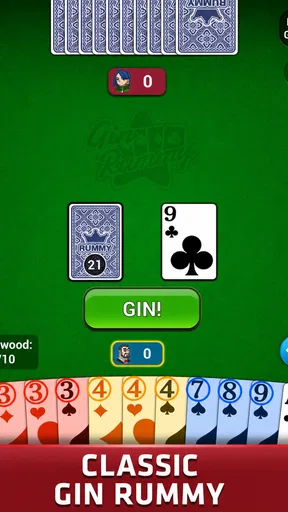
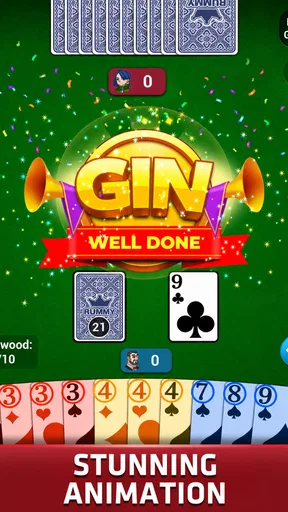
Our Review of Gin Rummy: Classic Card Game
 Analysis by Appyee
I like card games that respect a spare five minutes, and Gin Rummy: Classic Card Game fits that mood better than many larger mobile titles. It is a free card game from Topy Games, built around the familiar gin rummy format rather than a crowded collection of unrelated modes. I can open it for a quick hand, settle into a longer session, or play without an internet connection when I want something quiet.
That simple purpose is also the reason to consider it carefully. This is not a social card hub, a story-driven game, or a flashy competitive platform. Its appeal comes from making the decisions in gin rummy easy to reach on a phone. After spending time with it, I see the game as a practical choice for players who enjoy arranging cards, reading discards, and improving through repetition. It is less suitable for anyone looking for constant novelty, live interaction, or a deep progression system.
How the classic format feels on a phone
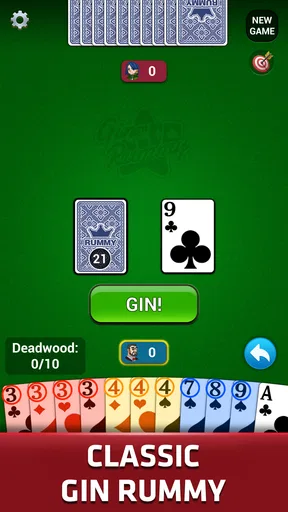
The basic rhythm is immediately recognizable: draw, decide what to keep, discard, and try to form useful combinations before the opponent does. That sounds straightforward, but the small decisions add up. A card that looks unnecessary early in a hand may become valuable later, while taking an obvious card from the discard pile can reveal too much about the hand I am building.
On a phone, that structure works because each turn is naturally short. I do not need to memorize a large rulebook or learn a complicated control scheme. The challenge is mental rather than mechanical. I spend my attention on the shape of my hand, the cards that have already appeared, and whether I should chase a promising combination or reduce deadwood before the other side gets ahead.
The offline focus is especially useful. I can play during a commute, in a waiting room, or somewhere with unreliable reception without treating the game as a service that needs constant access. That makes it different from many modern card games that depend heavily on online events, accounts, or multiplayer matchmaking. Here, the value is in having a dependable solo card experience available when I want it.
There is a trade-off, though. Offline convenience usually means the experience is centered on the game itself rather than a living community. Players who enjoy chatting with opponents, watching a ranked ladder develop, or joining scheduled events may find the format restrained. I would choose this game for concentration and repetition, not for a sense of belonging to a large online scene.
Learning the decisions instead of chasing speed
New players should resist the temptation to discard whatever seems least useful at first glance. Gin rummy rewards looking at several possibilities at once. A pair can become part of a set, two connected cards can support a run, and a hand with several almost-complete combinations can still be dangerous if its unmatched cards are expensive.
My most useful habit is to separate immediate improvement from information. Drawing from the discard pile may complete a combination, but it also tells the opponent what kind of cards I want. Drawing from the stock keeps my intentions less visible, even when the card itself is less exciting. That small distinction gives the game more depth than a basic “match cards and score” title.
I also recommend watching what disappears from the discard pile rather than focusing only on my own hand. If several cards from one sequence have already been rejected, continuing to wait for the missing card can waste turns. A safer approach is to keep flexible groups for as long as possible and commit only when the hand gives a strong reason to do so.
Another practical tip is to avoid treating every pair as equally valuable. A pair may be useful, but holding it too long can leave several unmatched cards around it. When the hand is not developing, I would rather preserve a flexible connector or reduce a high-value unmatched card than protect a pair simply because it looks tidy.
Progress without turning every hand into pressure
The game’s strongest form of progress is personal improvement. I notice better decisions when I stop reacting to each draw and start tracking what the opponent might be collecting. That makes repeated sessions worthwhile even when there is no elaborate reward structure pushing me forward. The satisfaction comes from recognizing patterns that I missed earlier.
Still, this style will not satisfy everyone. Players who need unlockable decks, character upgrades, missions, or a steady stream of new objectives may find the loop too narrow. A classic card game can remain interesting for a long time, but it asks the player to supply some of the motivation. I return because I want to play better, not because the app constantly presents a new prize.
That difference matters when considering spending. The game is listed as free, so the initial barrier is low. I can try the core experience without committing money simply to discover whether gin rummy suits me. At the same time, I would not assume that “free” automatically explains every possible purchase or monetization detail. The sensible approach is to treat the free entry point as confirmed, review any purchase screen personally before accepting it, and avoid spending merely to solve impatience.
For me, a good rule is to play several complete hands before deciding whether the game deserves a regular place on the phone. If the basic decisions are already enjoyable, additional options—if presented—should be judged as conveniences rather than necessities. If the core loop does not appeal, spending would not fix that underlying mismatch.
Fairness and the limits of what can be judged
Fairness in a card game is more complicated than whether a hand feels lucky. Random draws naturally create swings, and a strong opponent can make an ordinary deal feel harsher than it really is. I try to judge the game over multiple hands instead of treating one unlucky sequence as evidence that something is wrong.
The offline design is reassuring in one specific way: I am not depending on a live opponent’s connection or waiting for matchmaking to produce a session. It creates a contained environment where I can focus on the rules and my own choices. That does not prove anything about every internal decision the game makes, but it does make the experience feel less exposed to the pressures common in online competitive games.
I also appreciate that the game presents itself as a classic card experience rather than promising a grand competitive ecosystem. That sets a more reasonable expectation. I am not entering it expecting an official tournament ladder or a carefully balanced multiplayer economy. I am judging it as a focused way to play gin rummy on a mobile device.
There is an important limitation to that judgment. A high public rating and a large audience can suggest that many people enjoy the game, but they cannot personally verify every aspect of fairness for me. The title has an average rating of 4.9 from around 121 thousand ratings, and it has passed 5 million installs, which is strong evidence of broad appeal. I still base my trust on how clearly the game behaves during play, not on popularity alone.
The same caution applies to spending. I would not describe the game as aggressively monetized without seeing that behavior directly, and I would not promise that no purchase prompts exist. What I can say is that it is free to start, while the exact value of any optional purchase should be considered on its own terms. If a player wants a completely purchase-free environment with no uncertainty at all, a paid card game with a clearly stated one-time price may be a better fit.
Who will enjoy it in everyday use
A realistic use case is a short break between tasks. I might finish lunch early, put my phone aside from work notifications, and play a few hands offline. Because each turn is compact, I do not need to reserve an entire evening. I can stop after a hand without feeling that I have abandoned a team or interrupted a live match.
It also works for someone returning to card games after years away. The rules are familiar enough to make the first session approachable, while the discard decisions give experienced players something to refine. A beginner can concentrate on completing sets and runs; a more practiced player can think about information, timing, and the risk of holding deadwood too long.
I would recommend it to:
- People who want a focused offline card game for short or medium sessions.
- Players who enjoy improving through repeated hands rather than collecting content.
- Anyone who prefers traditional gin rummy rules and a straightforward mobile format.
- Users who want to try a free game before deciding whether it belongs in their regular rotation.
I would steer other players elsewhere. If your priority is live competition against friends, voice chat, seasonal rankings, or a broad multiplayer community, a connected card platform will probably feel more rewarding. If you dislike games where luck and imperfect information influence the outcome, gin rummy itself may frustrate you regardless of the app’s presentation.
Device fit, maturity, and practical expectations
The game supports Android devices running version 6.0 or later, which makes it accessible to people using older compatible phones as well as newer models. That is useful for a lightweight card title: I do not need to treat it as a reason to upgrade hardware. The age rating is Everyone, so its subject matter is broadly suitable for general audiences.
Topy Games released it on May 18, 2023, and the current version is 1.9.5.20260414. I mention the version because it is worth checking the store page before installing, especially if an older phone behaves differently from a newer one. Keeping the app updated is also a sensible way to receive the developer’s current fixes and adjustments rather than judging an outdated build.
The game has around 1.5 thousand written reviews alongside its much larger rating total. I find written feedback more useful than a single score when deciding whether to install: comments can reveal whether people enjoy the pace, understand the controls, and find the offline behavior convenient. Even then, I would give more weight to recent comments and to experiences from devices similar to mine.
One subtle advantage of a focused game is that it is easier to create a personal routine around it. I can use one session to practice reducing deadwood, another to focus on reading discards, and a third to play more aggressively. That turns repetition into deliberate practice instead of mindless tapping. The app does not need to provide a lesson for me to create one.
The limitation is that the game may not explain every strategic idea a newcomer needs. Someone completely unfamiliar with gin rummy may understand the actions but still wonder why a seemingly good draw was a mistake. I would recommend learning the basic scoring and meld concepts separately if the first sessions feel confusing, then returning to test that knowledge in actual hands.
My trust verdict after weighing the trade-offs
The main reason I trust this game as a recommendation is that its purpose is clear. It offers a traditional gin rummy experience, works offline, is free to begin, and avoids asking me to treat a simple card game as a massive entertainment platform. That clarity makes it easier to decide whether it belongs on my phone.
I would not oversell it as a complete replacement for every card-game alternative. A paid, ad-free title may be preferable for someone who wants a known one-time purchase and no interruptions. A multiplayer-focused app is better for social competition. A collection-based card game will offer more variety and long-term progression. Gin Rummy: Classic Card Game is strongest when I want the classic decision-making loop without those extra layers.
My spending advice is equally straightforward: start free, play enough hands to understand the rhythm, and treat any optional payment as a convenience rather than a requirement. Since the available purchase context does not establish a complete monetization picture, I would read each purchase screen carefully instead of assuming either the best or worst case. That is not a criticism unique to this title; it is simply good mobile-game judgment.
Overall, I recommend Gin Rummy: Classic Card Game to anyone who enjoys patient, compact card strategy and wants the freedom to play offline. Its best moments come from small improvements: discarding with a plan, keeping a flexible hand, and recognizing when a tempting card is actually a trap. I would skip it only if I need live social play, a rich reward system, or constant new content. For a clean, familiar gin rummy session on a compatible Android phone, Gin Rummy: Classic Card Game is an easy one to keep installed.
Privacy and Permissions
See what permissions an app requests and how it handles your data.
- Wi-Fi connection information
- view Wi-Fi connections
- Other
- view network connections, full network access, control vibration, prevent device from sleeping, Google Play license check
Verdict
Strengths of Gin Rummy: Classic Card Game
- Simple rules make it easy for beginners to start playing.
- Offline mode lets you enjoy matches without an internet connection.
- Adjustable difficulty provides a challenge for different skill levels.
- Quick rounds fit well into short breaks or casual play sessions.
- Clean card-focused design keeps the gameplay easy to follow.
Limitations of Gin Rummy: Classic Card Game
- Limited variation may feel repetitive after extended play.
- Advanced players may find the AI’s strategy predictable.
- Some features may require watching ads or making in-app purchases.
- Small card details can be harder to read on compact screens.
- Progression options are less engaging for players seeking deep rewards.
Other Releases by Topy Games
View All

Spelling Quiz - Word Trivia
Word4.8

Trivia Master - Word Quiz Game
Trivia4.5

Bible Trivia - Word Quiz Game
Trivia4.6
Similar Picks in This Category
View All
Solitaire - Classic Card Games
MobilityWare4.6

UNO!™
Mattel163 Limited4.3

Spider Solitaire: Card Games
MobilityWare4.6

Solitaire.com - Classic Cards
Tripledot Studios Limited4.7

Plants vs. Zombies™ Heroes
ELECTRONIC ARTS4.1

Hearthstone
Blizzard Entertainment, Inc.4.1
Frequently Asked Questions
What is Gin Rummy: Classic Card Game?
Gin Rummy: Classic Card Game is a digital version of the traditional two-player card game, designed for quick matches and casual play. After installing it, players can practice forming melds, such as sets and runs, while reducing the value of unmatched cards in their hand. It is generally easy to learn, although understanding when to knock or continue drawing takes practice.
How do you play Gin Rummy: Classic Card Game?
Each player receives cards and takes turns drawing and discarding while trying to organize their hand into sets of matching ranks or consecutive cards of the same suit. The objective is to achieve gin or finish the round with fewer deadwood points than the opponent. The app is suitable for beginners because the interface usually highlights the available cards and keeps the scoring process clear.
Can beginners enjoy Gin Rummy: Classic Card Game?
Yes, the game is accessible to newcomers, especially those who have never played physical Gin Rummy before. The basic turn structure is simple, and repeated matches help you understand card combinations, deadwood values, and the best time to end a round. However, beginners should expect a learning period because successful play depends on memory, timing, and predicting the opponent’s strategy.
Does Gin Rummy: Classic Card Game require an internet connection?
The connection requirements may depend on the version and the features offered by the developer. Offline play against computer opponents is commonly available in classic card-game apps, while online multiplayer, leaderboards, advertisements, or account-based features may require internet access. Before downloading, check the store listing and test the game in airplane mode if offline play is important to you.
Is Gin Rummy: Classic Card Game free to download and play?
The app may be available as a free download, but free versions can include advertisements, optional purchases, or limitations on certain features. These may involve removing ads, unlocking additional themes, accessing advanced opponents, or receiving extra gameplay options. Review the Google Play or App Store listing carefully before installing, particularly if you prefer a completely ad-free experience or want to avoid in-app spending.
Play our best games!


